
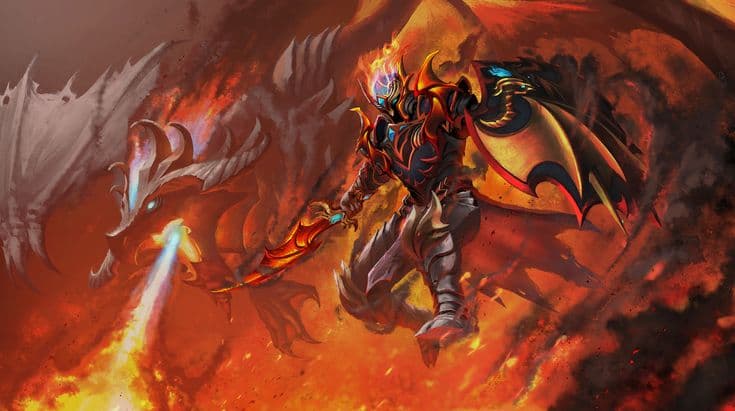
Dragon Knight — What Does a Hero Truly Need?
DOTABUFF - Dota 2 Stats
Dragon Knight is not a flashy hero. The first thing that comes to mind when someone mentions Dragon Knight is “vanilla”. It is a hero with a stun, a nuke, an armor, a regeneration passive, and an ultimate that turns him into a dragon. The latter part might sound exciting on paper, but it is far from it in an actual game. At the same time, Dragon Knight remains one of the most consistent and flexible heroes in the game, frequently picked by mids who are more than willing to sacrifice their own spotlight for a better chance at victory.
Recent trends show a steady growth for both Dragon Knight’s win and pick rates since the 7.07 balance patch hit the game, and looking at 7.07 changes as well as professional play for the hero, one thing definitely stands out — there is no single, dominant build for the hero. His item choices generally revolve around one or two core items, but depending on his talent choices, his role in the game can be vastly different. And that makes one of the safest and most reliable picks in the current meta.
The Medusa Treatment
Medusa made a comeback into high-level pubs and the professional scene with the changes introduced in 7.07, and to a great extent, it was the result of her talent changes. The level 20 +800 Mana talent might be the reason she was even considered in the first place, but it was level 10 and 15 talents that allowed her to keep on par with the rapidly accelerating metagame.
The same can be said about the Dragon Knight. 7.07b changed his level 15 talent that used to give +40% XP to a significantly more proactive +35 damage talent. Coupled with a +30 Attack Speed talent at level 10, it made Dragon Knight not only a very strong pushing tanky hero, but also a much bigger threat in teamfights.
However, it was merely a gateway to professional players noticing the hero, and currently, despite having higher success in pubs with a damaging build, the pro-scene is frequently concentrating on the utility aspects of the hero with a +2 mana regen and +300 health choices, further increasing the potential of the hero as a strong frontliner with decent control.
Initiation and Teamfight
Two items are purchased on the hero regardless of the game, and sometimes both of them are built together. Blink Dagger and Shadow Blade have become staples for the Dragon Knight, allowing him to initiate and get attention from the enemy, forcing them to either use their cooldowns to protect themselves or suffer a considerable amount of damage.
Blink Dagger is a vastly superior initiation item that can’t be countered with sentries and gives an instant projectile in melee form, doesn’t have a counterplay, apart from strong dispels from Abaddon, Legion Commander, or Oracle. At the same time, Shadow Blade allows the hero to deal even more damage, while having a situationally useful progression into Silver Edge.
Which of the items you need will change game to game, and there are games where having both can be the optimal choice. As a rule of thumb, however, you generally want Blink Dagger when playing against highly mobile heroes and when some of your teammates are interested in going Shadow Blade themselves, as the utility of invisibility goes down with extra sources of it on a given team.
Going for both is generally done to ensure better initiation when the enemy has vision heroes on their team, such as Keeper of the Light, Beastmaster, or Night Stalker. It is rarely used for its bonus damage and is more of a consistency boost to Dragon Knight’s initiation, especially when you are playing against a squishy target you absolutely can’t ignore.
Another reason to go both is the Silver Edge progression, a relatively cost-efficient item that can be game-winning in certain situations.
Regardless of your choice, Dragon Knight should almost always go for a Black King Bar, and this item is present in all of the professional matches on the hero, as it helps with initiation follow-up in terms of damage and survivability.
The latter part of the item progression is quite open-ended with frequent Bloodthorn, Assault Cuirass, Monkey King Bar, and Mjollnir pickups.
Closing Thoughts
Dragon Knight has 57% win rate in the pro-scene and 52% in the 5k+ games this month, making him one of the most successful heroes of the patch. Despite that, there are very few complaints about the hero, and no one seems to think that the hero is overpowered in the slightest.
As mentioned previously, he is one of the most reliable heroes in the game, but it is his flexibility that makes him rather powerful and in a way, unique. Dragon Knight starts the game as a jack-of-all-trades core: his laning stage is secure, but he isn’t particularly threatening either. He is relatively tanky, but isn’t as survivable as heroes like Tidehunter or Abaddon. He deals a decent amount of damage, but nowhere near actual hard carries. And he pushes relatively well, but not on the level of Death Prophet and the likes.
And it is up to the player to make the correct choices when it comes to Dragon Knight. What does this hero truly need? This is for you to decide.